Commercial Property Types Explained

Article Summary
- Commercial property offers higher rental yields and longer lease terms than residential investments, with five main sectors: offices, retail, industrial, hospitality, and specialist properties.
- Understanding use classes (Class E, Class B, sui generis) and ownership structures (freehold vs leasehold) is essential for successful investment decisions.
- Location, transport connectivity, and tenant quality determine investment success more than property type alone.
What Are Commercial Properties and Why Invest in Them?
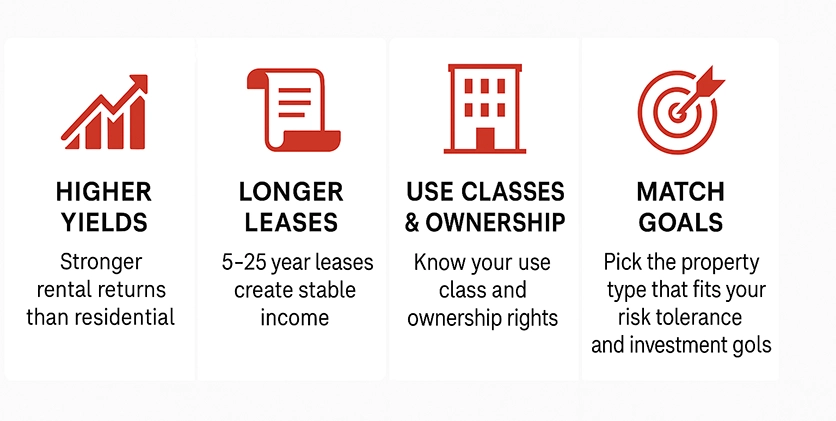
Commercial Property Offers Higher Yields, Longer Leases, and Stable Income for Diverse Investor Goals.
Commercial property is any real estate used for business purposes rather than residential living. It ranges from small corner shops to large distribution warehouses. Knowing the main property types is one of the first steps in learning how to invest in commercial property.
The UK commercial property market is one of the most established and liquid in the world, offering opportunities for higher yields, longer leases, and more reliable income streams. This combination helps smooth cash flow and reduce churn costs (the expenses tied to finding and replacing tenants) over the long term.
Commercial leases also bring greater stability. While residential tenants may leave with a month's notice, business tenants often commit to leases of five to 25 years. That kind of security reduces vacancy gaps and makes financing conversations easier.
Not all commercial opportunities follow this model. Land, for example, can be assessed using a land finance calculator, as financing depends on site value and exit strategy rather than ongoing rental income.
Office Properties
Office properties remain the backbone of many commercial property portfolios. Industry research consistently shows prime office yields in major UK cities sit in the 4-6% range. Lower yields can still be attractive if the tenant covenant is strong and the lease terms are long. In office investing, “covenant” refers to the tenant's financial strength and reliability to pay rent.
UK offices are generally grouped into three classifications: Class A buildings feature modern amenities and attract premium tenants; Class B properties offer solid returns in good locations; and Class C buildings require more hands-on management but can deliver higher yields.
City-centre properties can command £300 to £500 or more per square foot but need a higher upfront spend. Business parks usually sit around £150 to £250 per square foot. At those higher entry prices, it pays to focus on assets with solid demand drivers and strong transport links, ensuring your income is supported by fundamentals that endure over time.
Beyond traditional office space, serviced offices offer a different risk-return profile. Serviced offices can produce 8-12% yields compared with 4-6% for standard leases. The trade-off is the 10 to 15 hours of management most weeks, so the higher returns only make sense if you are prepared for that level of involvement.
Office Property Inspection Checklist
If you are new to office investing, start with these basics. They will help you avoid costly surprises during due diligence.
- Ceiling height and quality of natural light.
- Car parking ratios and access to public transport.
- Condition of HVAC systems and energy efficiency ratings.
- IT infrastructure and connectivity.
Office Investment Red Flags
- Insufficient parking ratios for tenant needs.
- Limited public transport accessibility.
- Outdated HVAC systems that might need major upgrades.
- Low energy efficiency ratings (EPC below B).
- Short remaining lease terms on leasehold interests.
Office Properties For Sale
Retail Properties
The most resilient retail properties are those that meet essential needs. Grocery stores, pharmacies, and service businesses usually see steady demand, even in weaker markets. This stability keeps footfall coming and supports occupancy and rent collection when times are softer.
Retail warehouses in out-of-town parks often deliver stronger yields than traditional high street shops, reflecting their resilience against e-commerce pressure. Typically, retail yields range from 5-7% for well-located properties with reliable tenants. Many leases operate on full repairing and insuring (FRI) terms, which shift maintenance costs to the tenant and improve net returns.
Focus on convenience retailers with strong covenants. Established chains such as Co-op often sign 10-to-15-year leases with built-in rent reviews, which give landlords visibility on income. In addition, properties on busy main roads with parking often outperform declining high streets.
Pro tip: Anchor tenants like major food retailers do not just pay rent. They also draw consistent traffic that supports neighbouring units.
Retail Property Inspection Checklist
- Visibility of shop frontage and street positioning.
- Footfall patterns at different times and days.
- Availability and ease of parking.
- Density of competition and quality of tenant mix in the area
Retail Investment Red Flags
- Declining footfall trends in the area.
- High vacancy rates in surrounding properties.
- Heavy reliance on a single anchor tenant.
- Limited parking or poor transport accessibility.
Retail Properties For Sale
Industrial Properties
Alongside retail, industrial assets are a core segment of UK commercial property. Market studies highlight that last-mile delivery facilities of 10,000-50,000 square feet often achieve 6-8% yields on 10-to-15-year leases. Those longer leases and modern specifications make reletting easier and help protect your income.
Generally, large distribution hubs of more than 100,000 square feet offer lower initial yields of 4-6%. However, they provide exceptional stability with 15-to-25-year leases. Because companies face high disruption costs when relocating, these assets suit investors who value predictability and long-term security.
Prime location revolves around transport connectivity. Properties near motorway junctions can command rental premiums of 20-30 %. Modern specs matter, too. Tenants now expect eight to 10 metre eave heights, level-access loading, and three-phase power. Three-phase power supports heavier equipment and higher electrical loads, so you will not be caught out by tenants later saying the building cannot support their operations.
Pro tip: Properties already built to modern specifications usually re-let faster and save you the retrofit costs that can erode returns.
Industrial Property Inspection Checklist
- Adequate eaves height (at least 8-10 metres for modern use).
- Floor loading capacity and surface condition.
- Availability of three-phase power supply and overall electrical capacity.
- Vehicle access, turning circles, and loading arrangements.
Industrial Investment Red Flags
- Power supply insufficient for modern operations.
- Poor transport links or weight restrictions on surrounding roads.
- History of environmental contamination on site.
- Ceiling height inadequate for modern racking or storage systems.
Industrial Properties For Sale
Hospitality Properties
Hospitality assets are another key segment of the UK commercial property market. Hotel investments can generate strong returns but tend to require more involvement than other types of commercial property. For investors seeking income growth rather than pure stability, budget hotels in business travel hubs often provide attractive, risk-adjusted returns. Franchise operations with established brands reduce management complexity and give you brand recognition that shortens ramp-up time and supports repeat demand.
Pubs and restaurants for sale offer opportunities for investors who understand the dynamics of the hospitality sector. In fact, freehold pub investments can produce multiple revenue streams through both property appreciation and rental income. Restaurant properties in prime locations can command substantial rents from successful operators.
However, because many restaurants fail, it pays to choose tenants carefully and structure leases with turnover in mind. Deposits and rent reviews can be used to reflect operator performance and safeguard your income.
Specialist Commercial Properties
Healthcare properties are one of the steadiest parts of the market. GP surgeries typically sign 10-to-25-year NHS-backed leases, and dental or veterinary clinics offer similar security, often with slightly higher yields. Many of these sites involve major fit-outs. That big spend locks tenants in and cuts your vacancy risk, but it can also mean a longer wait to re-let if the property is highly specialised. For retirement-focused investors, NHS-backed leases in particular provide the kind of long-term, low-maintenance income that aligns with capital preservation goals.
Alternatively, student accommodation can deliver consistent occupancy in established university towns. Modern properties with en-suite facilities generally command £120 to £200 per week compared with £80 to £120 for older housing. Because income often clusters around September and January intakes, it's sensible to set aside a reserve to cover quieter months.
Mixed-Use Properties
For investors seeking income diversity, mixed-use properties combine more than one type of use within a single building. For example, a property might generate £25,000 a year from ground-floor retail space and £30,000 from upper-floor offices.
That equates to a total income of £55,000 on an £800,000 investment. This equates to a gross yield of about 6.9% before financing and costs, showing how multi-use assets can balance income streams while spreading tenant risk.

How Do Use Classes and Ownership Types Impact Commercial Property Investments?
Use Classes Govern Permitted Activities, While Ownership Types Influence Costs, Yields, and Investment Flexibility.
Most UK commercial properties are grouped into a few main planning classes. Class E covers offices, retail units, and light industrial uses. Class B is for general industrial and storage, while pubs and takeaways usually fall under sui generis and need specific planning consent.
When you buy, you'll either purchase the freehold, meaning you own the building and land outright, or the leasehold, where you own the property for a set number of years but pay ground rent to the freeholder. Ground rent is often £500 to £5,000 a year and reduces your net income, so always ensure your rent after costs comfortably covers loan payments.
Key Takeaways
Understanding the main types of commercial property in the UK gives investors a solid foundation for making informed decisions. Each property has its own characteristics, yield potential, and management demands that align with different goals and levels of experience.
The key to success is matching the property type to your own situation and risk tolerance. A clear view of how commercial property is sold can support decisions about growth and timing. Whether the aim is to supplement income, build long-term wealth, or grow a substantial property portfolio, the commercial property market offers established pathways to achieve those ambitions.
